

That’s where YD tungsten carbide composite rods step in as a cost-effective hardfacing solution. In this guide, we break down its core construction, key specs, functional advantages, cross-industry applications and practical operating tips to help you judge whether this composite welding rod fits your component repair needs.
1. What Is Tungsten Carbide Composite Rod?
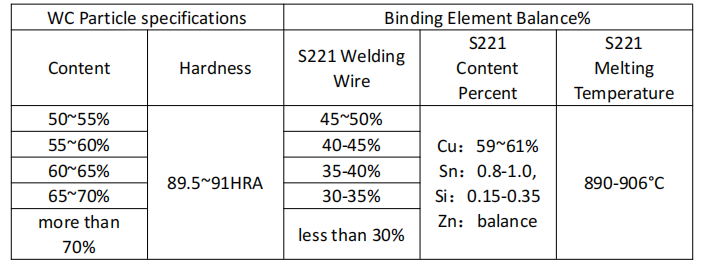
- YD tungsten carbide composite rods standard formulation: 60%~70% tungsten carbide particles + 30%~40% S221 binding alloy.
- The S221 sheath consists of Cu 59~61%, Sn 0.8~1.0%, Si 0.15~0.35% and balanced Zn, with a fixed melting point of 890~906°C, perfectly matched for oxy-acetylene brazing.
- After hardfacing deposition, the finished overlay delivers consistent hardness ranging from 89.5~91 HRA (≈HRC67–69), far superior to regular hardfacing alloys.
2. How YD tungsten carbide composite rods Differs From Traditional Hardfacing Welding Rods
- Ordinary iron-based hardfacing electrodes: Low hardness around HRC45~55, fast abrasion loss, components require re-welding every few hundred working hours; low upfront cost but high long-term maintenance spending.
- Chrome carbide hardfacing rods: Moderate wear resistance (HRC58~62), yet highly vulnerable to spalling and crack failure under cyclic impact loads, commonly seen on mining and drilling parts.
- YD Tungsten Carbide Composite Rods: The dual-structure design combines ultra-hard WC grit for anti-abrasion performance and ductile S221 copper alloy for impact resistance. Its 89.5~91HRA overlay balances wear-proof and anti-spalling capacity, extending component service life by 3~5X versus conventional alternatives in most field environments.
3. Key Functional Benefits of ZZT21 Tungsten Composite Rods
- Superior Wear & Impact Resistance: High-content Tungsten Carbide Grits form a dense hard working layer to resist sand, rock and slurry abrasion; flexible copper binder prevents cracking and flaking under shock load.
- Low-Temp Oxy-Acetylene Brazing: S221 melts at 890~906°C, no high-power welding machine required, convenient for on-site field repair in remote mines or oilfield sites.
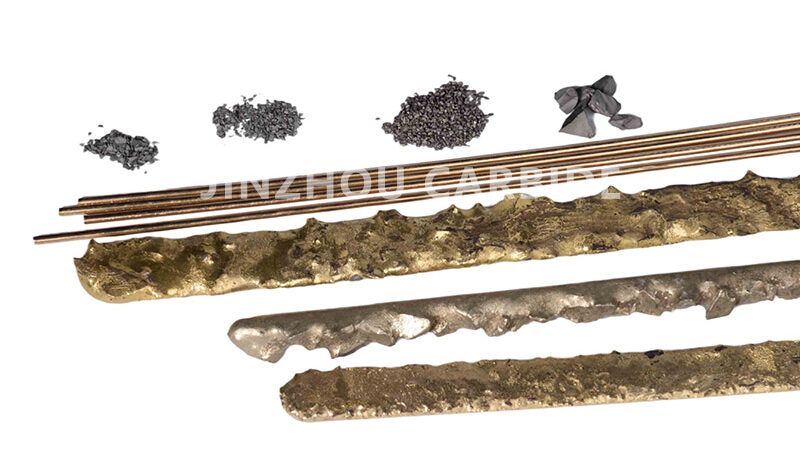
- Diversified Customization: Variable WC content (50%~70% optional), 6 Tungsten Carbide Grits sizes and 4 Brass Welding Wire dimensions, enabling targeted matching from tiny precision parts to large heavy-duty equipment.
- Reduced Total Ownership Cost: Less frequent re-hardfacing cuts downtime, labor and spare-part procurement costs for factories and service workshops.
4. Wide Industry Applications
✅ Oil & Gas Downhole Tools (your original content optimized)
✅ Mining & Coal Industry
✅ Agriculture & Sugar Mill
✅ Construction & Geology
5. Basic Operating Guidance for ZZT21 Brazing
- Clean base metal surface thoroughly to eliminate rust, grease and oxide before brazing to avoid poor bonding and post-weld peeling.
- Preheat mild steel substrate moderately to reduce thermal stress and overlay cracking risk.
- Control flame temperature to melt the outer S221 binder evenly; embedded WC particles stay intact and evenly distributed inside the deposited hardfacing layer.
6. FAQ
A: Yes. Its S221 copper-based binder features excellent metallurgical bonding with carbon steel; proper preheating is the key to achieve crack-free overlay.
A: Fine grit (1.6~4.8mm) + Φ12 small rods for light-abrasion blades/rollers; coarse grit (6.4~12.7mm) + Φ16/22mm large rods for high-impact mining drill & crusher components.
A: Main causes include uncleaned workpiece surface, improper preheating or mismatched rod grade for working load; our technical team provides free grade selection support.
A: Consistent 89.5~91HRA across all ZZT21 WC content grades.